Tuesday, June 25, 2013

Monday, June 24, 2013
Nelson Mandela in critical condition days before Obama visit

Former South African President Nelson Mandela's family visited him Monday as he lay in a hospital bed in critical condition.
His ex-wife Winnie Madikizela-Mandela and daughters Zindzi Mandela-Motlhajwa and Zenani Mandela-Dlamini spent time with him at the Medi-Clinic Heart Hospital in Pretoria, the South African Press Association reported.
Government officials paid visits as well.
His wife, Graca Machel, spends every night at the hospital, where the former president has been since June 8 for a recurring lung infection. Previously, authorities had described his condition as serious but stable.
But over the weekend, his health took a turn for the worse, with the South African president's office saying he was in critical condition.
"The doctors are doing everything possible to ensure his well-being and comfort," President Jacob Zuma told the nation Monday.
The former president's health will not affect U.S. President Barack Obama's planned visit to the country this week, Zuma said, according to the press association.
Mandela, 94, has become increasingly frail over the years and has not appeared in public since South Africa hosted the World Cup in 2010.
Outside the hospital Monday, a security wall was awash with get-well cards, balloons, flowers, cards and paintings, the press association reported.
Ready for the spiritual realm
For Mandela's family, these are very personal times -- times to be cherished as the end nears.
"I believe he is at peace," said Makaziwe Mandela, who was born in 1953 to Mandela's first wife, Evelyn.
"All we do every day is take one day at a time and pray to the good Lord," Makaziwe told CNN's Robyn Curnow.
"All I pray for as a daughter is that the transition is smooth. ... He is at peace with himself. He has given so much to the world."
In and out of hospital
The anti-apartheid hero has been in and out of the hospital in recent years.
His history of lung problems dates to when he was a political prisoner on Robben Island during the apartheid era, and he has battled respiratory infections.
Considered the founding father of South Africa's democracy, Mandela became an international figure while enduring 27 years in prison for fighting against apartheid, the country's system of racial segregation.
South Africa's governing African National Congress noted "with concern" Sunday the change in Mandela's health.
"The African National Congress joins the presidency in calling upon all of us to keep President Mandela, his family and his medical team in our thoughts and prayers during this trying time," it said.
A Nobel laureate
In 1993, Mandela and then-South African President F.W. de Klerkjointly won the Nobel Peace Prize.
The iconic leader was elected the nation's first black president a year later, serving only one term, as he had promised.
Even as he has faded from the spotlight, he remains popular and is considered a hero of democracy in the nation. Last year, South Africa launched a new batch of banknotes with a picture of a smiling Mandela on the front.
His impact extends far beyond South Africa. After he left office, he mediated conflicts in Africa and the Middle East.
Word of his worsening health drew global expressions of concern.
"We have seen the latest reports from the South African government that former President Mandela is in critical condition," Caitlin Hayden, a U.S. National Security Council spokeswoman, said in a statement. "Our thoughts and prayers are with him, his family and the people of South Africa."
Friday, June 21, 2013
Heart attack killed 'Sopranos' star James Gandolfini
STORY HIGHLIGHTS
- NEW: Autopsy confirms heart attack as cause of Gandolfini's death, official tells CNN
- Doctors will provide a final report on his death later in the day
- Gandolfini was taken to a Rome hospital Wednesday after falling ill at his hotel
- The actor was scheduled to receive an award at an Italian film festival
Rome (CNN) -- An autopsy has confirmed that actor James Gandolfini died of a heart attack, an Italian official familiar with the autopsy results told CNN on Friday.
Gandolfini, 51, died Wednesday while vacationing in Italy. Hotel staff reportedly had to break down the door to his bathroom to get to him after his son, Michael, alerted them.
Doctors had not noted any suspicious factors, such as alcohol, on his medical report, emergency room physician Claudio Modini said.
A van ferrying relatives of the deceased "Sopranos" star arrived Friday at the hospital morgue in Rome where his body lies. They were expected to speak to reporters about Gandolfini's death later.


Died at his hotel
Gandolfini's son Michael alerted hotel staff after his father did not answer his knocks, said Tiziana Rocca, the head of a film festival the actor was scheduled to attend.
Staff then broke down a bathroom door to get to him, said Rocca, who spoke with Gandolfini's son by telephone.
The hotel called an ambulance.
Death certificate
Before Italian authorities can release his remains for transport back to the United States, the U.S. Embassy in Rome must issue a death certificate.
The U.S. Embassy said it was "deeply upset" by the news of the actor's death, but had not received any official confirmation from local authorities.
It said the family will get assistance from the embassy when it requests it.
Had he survived
Gandolfini was to arrive Friday in Taormina in Sicily, a quaint town packed with historical architecture and nestled between lush green hills and the azure waters of the Mediterranean Sea.
There, he would have received an award at the Taormina Film Festival, set in the ruins of an ancient Roman arena.
Festival organizers announced their deep sorrow over his passing and will replace the award ceremony with a tribute to Gandolfini's lifetime achievements.
They believe that no one has ever portrayed the Italian-American saga as brilliantly as he did.
Breath No More
I've been looking in the mirror for so long.
That I've come to believe my soul's on the other side.
All the little pieces falling, shatter.
Shards of me,
Too sharp to put back together.
Too small to matter,
But big enough to cut me into so many little pieces.
If I try to touch her,
And I bleed,
I bleed,
And I breathe,
I breathe no more.
Take a breath and I try to draw from my spirits well.
Yet again you refuse to drink like a stubborn child.
Lie to me,
Convince me that I've been sick forever.
And all of this,
Will make sense when I get better.
But I know the difference,
Between myself and my reflection.
I just can't help but to wonder,
Which of us do you love.
So I bleed,
I bleed,
And I breathe,
I breathe no...
Bleed,
I bleed,
And I breathe,
I breathe,
I breathe-
I breathe no more.
That I've come to believe my soul's on the other side.
All the little pieces falling, shatter.
Shards of me,
Too sharp to put back together.
Too small to matter,
But big enough to cut me into so many little pieces.
If I try to touch her,
And I bleed,
I bleed,
And I breathe,
I breathe no more.
Take a breath and I try to draw from my spirits well.
Yet again you refuse to drink like a stubborn child.
Lie to me,
Convince me that I've been sick forever.
And all of this,
Will make sense when I get better.
But I know the difference,
Between myself and my reflection.
I just can't help but to wonder,
Which of us do you love.
So I bleed,
I bleed,
And I breathe,
I breathe no...
Bleed,
I bleed,
And I breathe,
I breathe,
I breathe-
I breathe no more.
Tuesday, May 21, 2013
Eminem publisher sues Facebook

Eminem’s song publisher is suing Facebook and its ad agency, claiming they infringed the Detroit rapper’s copyright.
In the 12-page complaint, filed Monday evening in Detroit federal court, Ferndale-based Eight Mile Style contends that a Facebook ad that was broadcast online April 4 copied music from Eminem’s 2000 song “Under the Influence.”
The 30-second ad, dubbed “Airplane,” was featured in a webcast by Facebook chief Mark Zuckerberg to announce Facebook Home, an interface for Android phones. Some viewers at the time noted a similarity between the ad’s music and Eminem’s song.
Eight Mile Style oversees rights and licensing for Eminem’s song catalog.
The complaint claims the ad agency, Wieden+Kennedy of Portland, Ore., copied Eminem’s music “in an effort to curry favor with Facebook by catering to Zuckerberg’s personal likes and interests, and/or to invoke the same irreverent theme” of the rapper’s song.
A Facebook spokesperson declined to comment on the suit. The Free Press has contacted an attorney for Wieden+Kennedy seeking comment.
A version of the commercial featuring new music was posted to YouTube several days later. That version has also since aired on television.
The lawsuit contends the alteration “was an admission that Facebook knew it had infringed” on the Eminem song.
This isn’t the first time Eight Mile Style has taken on a tech giant: Apple Inc. reached an out-of-court settlement with the publisher in 2005 after using Eminem’s “Lose Yourself” in an iPod commercial without permission.
Audi agreed to a settlement in 2011 after using a “Lose Yourself” sound-alike song in a European promotional clip.
The Facebook Home media event took place in early April — the same week that web sleuths made headlines by purportedly turning up the old Angelfire homepage of a teenage Zuckerberg.
That site includes an “About Me” page that cites Eminem’s best-known persona: “Hi, my name is ... Slim Shady. No, really, my name is Slim Shady. Just kidding, my name is Mark.”
Further twisting the plot: Wieden+Kennedy was the firm behind Eminem’s famed Super Bowl spot with Chrysler in 2011 — which featured an authorized version of “Lose Yourself.”
Eight Mile Style had directly complained to the ad agency in April about the Facebook ad music. In an April 29 response obtained by the Free Press, a Wieden+Kennedy attorney argued that Eight Mile Style had no grounds to assert copyright, saying the Eminem song passage had itself been copied from Michael Jackson’s 1991 song “Give In to Me.”
In the letter, attorney Guy Cohen attributed the writing and production of “Under the Influence” to periodic Eminem collaborator Dr. Dre, who Cohen contended “has a long, well-documented history of copyright infringement.”
“Under the Influence” was in fact cowritten by D12 and produced by the Bass Brothers, the Detroit duo who handled much of the rapper’s work at the time.
“I find it so arrogant, after they did so well with the Chrysler-Eminem campaign, that they would say Dr. Dre stole this from Michael Jackson,” said Eight Mile Style head Joel Martin.
Even setting aside any Michael Jackson issue, Cohen wrote, the music in the original Facebook spot “simply is not substantially similar” to the Eminem song.
Moreover, he wrote, Wieden+Kennedy has “taken steps to ensure that the earlier version of (the Facebook ad) is no longer publicly available.”
Contact BRIAN McCOLLUM at 313-223-4450 orbmccollum@freepress.com.
Wednesday, May 1, 2013
Upon Which I Rubik's Cube

Picture, for a moment, that the reality which surrounds you is a Rubik’s Cube and your consciousness is the imprisoned, invisible sphere at the center. The 3-dimensional blocks which revolve around you keep you in your place and are, for all intents and purposes, your reality. You have full ability to move those particles around into other colorful sequences, but you are still a captive.
Now, move back from that Rubik’s Cube and realize that there are other conscious minds out there, also imprisoned in their ‘squared circles.’ They are all imprisoned as well, albeit connected by wispful threads of consciousness which can make quantum leaps in between one another to communicate. These wispful threads are ‘the wave’--something that the sphere excels at without even trying. The functioning of the wave is something that cube itself cannot comprehend. The cube only understands rules.
It is rather strange, is it not, that communication can still take place if we buy the argument that all our brains have to work with are these blocky logic structures. Where one man visualizes ‘cup’ in one manner, another man visualizes it in a different manner, but regardless of the differences in visualization, both parties know and can communicate what they mean when they say ‘cup.’ There is no ‘shared cup’ anywhere that both parties are referring to, but they are still able to describe what they mean and be perfectly understood. Why? Because communication between all of us occurs on the astral plane, and those hardcoded versions of the cup are elements of our own imprisonment--the squares on the outside of our Rubik’s Cube.
The cube itself depends on the spherical consciousness at its center for all function, all movement. If the pieces are handed to us from a supposed higher power and presented to us as ‘reality’, since it is all we have to work with, how would we know that there are other worlds, other semblances, other things besides the colored squares around us? The invisible sphere of consciousness may be forced into its configuration, but there are obviously other configurations. The question is at which point we can experience those other configurations.
Salvador Dali drew the interconnected network of consciousness that forms humanity in his painting of the crucifix in which Jesus was nailed to a hypercube. All those cubes, unfolded, becomes the cross, and humanity is made up of well over 6 billion of them, all imprisoned, with the Pheonix rising above it all.
The ‘programming’ we all have is not only made up of the cubes that surrounds us, but also is a direct result of the color configuration that we must somehow unlock to return the cube to its restful state. We spend our entire lives doing this as we stare at other cubes around us, watching how they turn and shape themselves and work to reconfigure themselves. We notice one another’s movements, remember how they did it, and work to do the same. Our ‘free will’ is our ability to work and unlock ourselves--if we so choose. Or we can stay delirious with our colors mixed and matched. Every effort we make in life is to unlock the pure color scheme, but in the end, we remain at the center of it all, and it makes us wonder whether or not it even matters that we tried. We have that choice--to make it matter, or remain drunk at the center, unaware of the chaotic scheme of our lives around us.
We are given a ‘preconfigured’ set of blocks around us with a certain color scheme. Every life we live, we carry it to the next until we prove ourselves to those who gave us the blocks to configure that the conscious sphere at the center can achieve what seems to be the impossible--unlocking the cube. Only then will we achieve enlightenment.
But how does one unlock the cube? By knowing the rules and using them. The sphere believes in ignorance that the rules act against it--whereas the cube knows the rules are for the sphere and not against it at all. One who fully comprehends the ruleset are the ones who can use it all to unlock themselves. The truth, to the sphere, is that they are imprisoned by rules. The truth, to the cube, is that the sphere is not imprisoned at all, but in need of growing through limits, by understanding what it is like to HAVE rules and impossibilities. The cube provides the ruleset--the sphere is there to learn them and to follow the path towards enlightenment.
At certain stages in life, the sphere knows the sequence it must complete. They may do so, kicking and screaming at the complexity of it all, or they may do so at peace with themselves, knowing there is no other way. It is a choice.
We know not who gave us the cube and trapped us here, or if we are truly ‘trapped’ at all. Perhaps we entered of our own free will. Was it aliens who created the cube? God? If so, why is it harder for some rather than others to unlock themselves? Is there favoritism? And what will happen when we do unlock it?
One set of spheres is at peace with the rules, the other set is not. I am one of those who has spent the majority of his life not at peace--one who sits, indian style, arms crossed, telling the world that I would rather be than do. But the colors remain mixed--I am delirium. I don’t play by the rules, for I believe the rules do not apply to someone who is at peace. But even though I tell myself I am at peace, no one is showing me the way out. There may be only one way--the sequence--I simply, stubbornly, choose to look for another. Did Dali, in his delirium, eventually find it? I turn my head and observe his sequence, and wonder: the first step may be to believe that our prison is not a prison at all, but a puzzle given to us by a higher power.
I’ve written of the cube in The Hologram, in the Tetragrammaton, on pages and pages of this website. I can see it with crystal clarity when I observe the angels and their constituent demons. And now, the hypercube painting of Dali says to me one thing: try again. For there is no evidence that, at the end of this life, we will be freed from our responsibilities to unlock ourselves. That final sequence is up to us. Only then will we be cured of delirium. Only then will we cease to be puzzled. Only then will we make it home.
The rules are there--they’re just not against you. Know them. Use them. Besides trying again, it is the only way.
Written By: Jeff Behnke
Saturday, April 27, 2013
Snake arms and crystal legs: Artificial limbs push boundaries of art
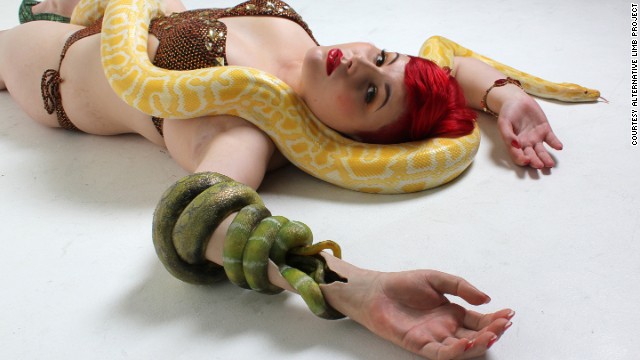 London (CNN) -- With her flaming red hair, Marilyn Monroe figure, and lurid green snake casually coiled around the arm, Jo-Jo Cranfield looks like a real-life muse emerging from a Salvador Dali painting.
It's impossible not to stare at the neon python on her left wrist. But take a closer look and you'll discover that the reptile slithers in and out of the flesh like a psychedelic needle and thread.
Cranfield is an amputee. And her fantastical arm -- described as everything from cool to creepy, and erotic -- is the work of a London designer reinventing the way we see prosthetic limbs.
From stereo legs to feather arms, Sophie de Oliveira Barata'sAlternative Limb Project crosses into the realm of surrealist art, yet with a very important function.
"It's drawing attention to their disability in a positive way," said de Oliveira Barata. "Rather than people seeing what's missing, it's about what they've got.
Having an alternative limb is about claiming control and saying 'I'm an individual and this reflects who I am.'Sophie de Oliveira Barata, Alternative Limb Project
"Having an alternative limb is about claiming control and saying 'I'm an individual and this reflects who I am.'"
Superhuman
De Oliveira Barata's remarkable work was thrust into the international spotlight last year when model and singerViktoria Modesta wore her Swarovski crystal leg at the London Paralympics closing ceremony.
Artificial limbs are usually designed to be as inconspicuous as possible. Yet here was an amputee proudly stretching her bejeweled leg before a stadium of flashing cameras and millions of TV viewers across the world.
"Generally the whole technology is moving towards trying to recapture a lifelike limb that looks realistic and also acts realistic in motion," said de Oliveira.
"In this instance I'm doing the complete opposite and I think it does capture that whole childlike imagination -- it's like being a superhero with super powers."
Loud and proud
For Latvian-born Modesta, who had her left leg amputated below the knee as a teenager due to ongoing health problems, alternative limbs are as much a way of expressing herself as the clothes she wears.
"Being a self-confessed fashionista, things that I'm into tend to change all the time, and like most key pieces in my wardrobe I would only wear it a number of times," she said.
"The first time I wore a limb that was so obviously bionic, it gave me a total sense of uniqueness and feeling mutant human in the best way possible."
Similarly Cranfield, who tends to wear her snake arm on nights out with friends, says it makes her feel powerful and sexy.
"I wanted people to have to look at me twice with amazement," said Cranfield, a motivational speaker and para triathlete, who was born without an arm below the elbow.
I'd rather people just asked me outright how I lost my arm. This is so out there ... that it makes people feel OK to ask questions.Jo-Jo Cranfield, Paralympian
"I'd rather people just asked me outright how I lost my arm. This is so out there -- like I'm wanting you to look at me -- that it makes people feel OK to ask questions."
A special effect
After studying special effects prosthetics for film and TV, de Oliveira Barata worked with a realistic prosthetics company for eight years, continuing to experiment with artistic limbs in her spare time.
In 2009 she contacted Modesta with her unique idea for an alternative limb company, and the pair began collaborating on a groundbreaking stereo leg, replete with speakers and stiletto shoe.
The prototype was a success and de Oliveira Barata's clients now range from ex-military men looking for a sci-fi leg to children wanting a secret compartment to store their pencils.
The bespoke limbs cost between $4,600 and $21,000. Materials vary according to each design, but must be durable, lightweight, and water resistant.
In Britain, the National Health Service currently only funds realistic limbs. But De Oliveira Barata argued that alternative prostheses could be just as beneficial.
"The dominant thinking is that a new limb should be as close a match to the previous limb as possible," she said. "But until technology gets to the point where you can have a realistic looking limb in movement and aesthetics, there will always be this uncanny middle ground.
"Having an alternative limb embraces difference and can help create a sense of ownership and empowerment."
Moving with the times
Not just aesthetically pioneering, de Oliveira is now working on a new series of limbs with alternative functions.
Swiss army knife arms with fold-out tools, nightclubbing legs that light up to music, and cooking arms with different attachments for kitchen appliances, are just some of the futuristic designs she's been working on as part of the project with special effects students at Hertfordshire University, in England.
There is something undeniably playful about the project. After all, one of Cranfield's favorite tricks is walking around with her snake arm poking out the top of her bag.
"It provokes some strange reactions," she admitted. "But I've never wanted to just fit in -- I've always wanted to be different."
Subscribe to:
Comments (Atom)